
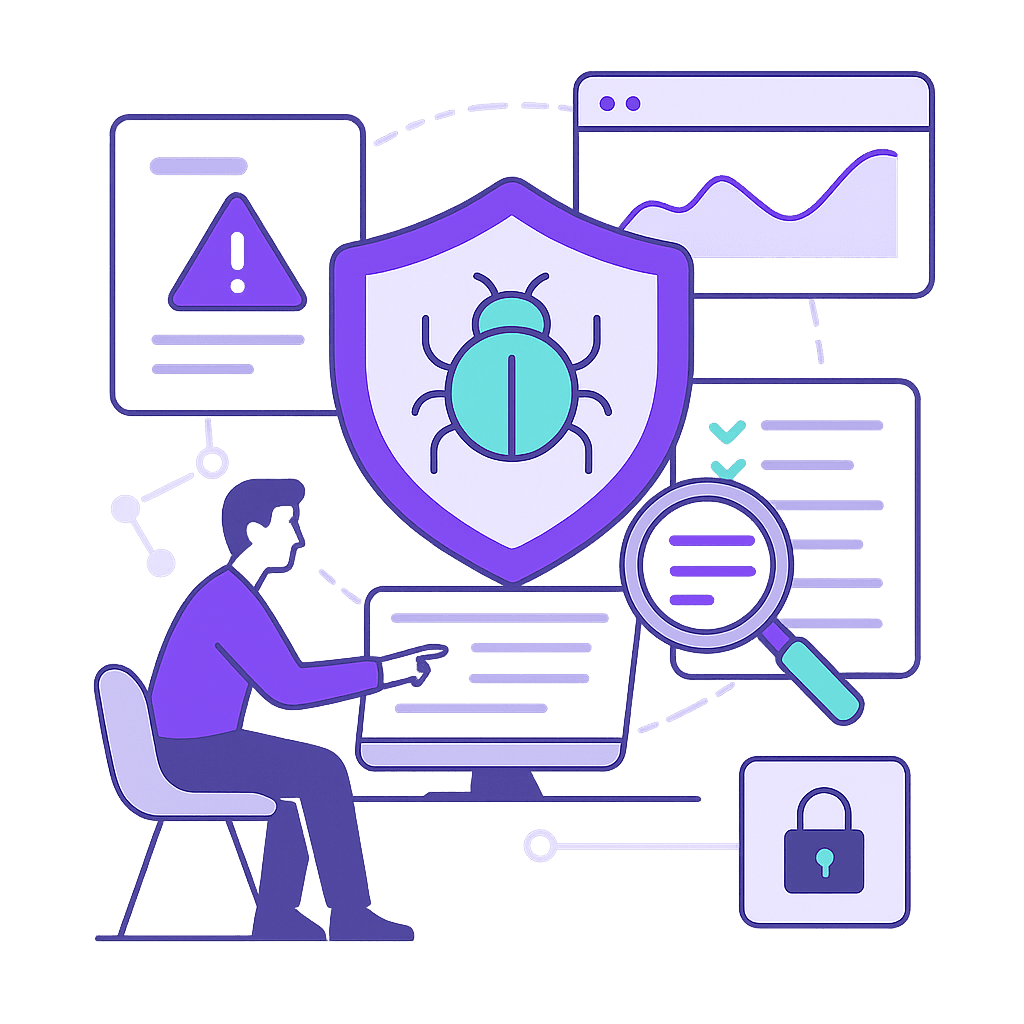
APIs power modern applications. Mobile apps, cloud platforms, and microservices communicate through API endpoints that directly expose backend functionality. Every exposed endpoint expands the attack surface, which makes API security testing essential for protecting data and business logic.
Industry research shows that vulnerable APIs and automated bot attacks are now costing businesses up to $186 billion annually, highlighting the growing financial impact of insecure API ecosystems.
No single testing method can fully evaluate API security. Automated scanning helps identify weaknesses across large API inventories, while manual penetration testing investigates how attackers could exploit those weaknesses.
Both methods answer different security questions and play different roles in modern API security strategies. Understanding the difference between API scanning and API penetration testing helps security teams choose the right strategy for protecting modern API driven systems.
Why API Security Testing Requires Multiple Approaches?
APIs connect mobile apps, web platforms, microservices, and third party integrations. Each exposed endpoint provides direct access to backend functionality, which increases the potential attack surface. Security teams, therefore, treat API security testing as a critical part of protecting cloud native applications.
Modern systems often contain hundreds of API endpoints running across distributed services.
Recent industry research shows that 99% of organizations experienced at least one API security issue in the previous year.
Risks such as broken authentication, excessive data exposure, and insecure authorization can appear at different layers of the architecture. The OWASP API Security Top 10 highlights these common threats in modern APIs.
Different testing approaches exist because no single method can identify every weakness. Automated API scanning provides scalable coverage across endpoints and helps teams monitor security continuously within CI/CD pipelines. API penetration testing adds deeper investigation by validating whether vulnerabilities can actually be exploited in real attack scenarios.
What Is API Scanning?
API scanning is an automated security testing method that analyzes API endpoints to identify vulnerabilities, misconfigurations, and unsafe behaviors. Security scanners send crafted requests to APIs and evaluate responses to detect weaknesses such as authentication flaws, sensitive data exposure, or poor input validation.
Many organizations integrate API scanners into CI/CD pipelines so security checks run continuously during development and deployment. Automated scanning helps teams test large numbers of endpoints quickly, which is essential for microservice environments where APIs change frequently.
Tools that support API scanning often rely on specifications such as OpenAPI or Swagger to map endpoints. Platforms like Burp Suite and OWASP ZAP then automate requests, analyze responses, and flag patterns linked to common API security risks.
How API Scanners Work?
API scanners begin by discovering endpoints. They read API specifications such as OpenAPI or observe application traffic to enumerate available routes, parameters, and request structures. Security teams often supply authentication tokens so scanners can test protected endpoints as real users would.
After discovery, the scanner generates automated requests that probe the API for weaknesses. Parameters are mutated, payloads are modified, and responses are analyzed for abnormal behavior. Techniques such as fuzzing, schema validation, and request replay help identify issues in input handling and authentication flows.
Many scanners also test APIs that rely on authentication frameworks like JWT or OAuth. Response patterns, error messages, and status codes help detect known vulnerability signatures across large API environments quickly.
What API Scanning Detects Well?
API scanners perform best at identifying common and pattern based security weaknesses across many endpoints. Automated checks can quickly reveal authentication misconfigurations, weak input validation, and missing controls such as rate limiting. Security teams often use scanners to uncover endpoints that expose sensitive data or respond with overly detailed error messages.
Scanners also detect vulnerability patterns mapped to the OWASP API Security Top 10. Examples include insecure authentication handling, improper schema validation, and misconfigured transport protections like TLS.
Automated detection works well because scanners compare responses against known weakness signatures. Large API environments benefit from this capability since hundreds of endpoints can be checked consistently and repeatedly without manual effort.
What Is API Penetration Testing?
API penetration testing is a manual or hybrid security assessment where specialists simulate real attackers to uncover exploitable weaknesses in APIs. Unlike automated scanning, the goal is not only to find vulnerabilities but to understand how an attacker could abuse them in real scenarios.
Security professionals review API documentation, authentication models, and request flows to identify weaknesses that automated tools often miss. The process follows structured guidance such as the OWASP Web Security Testing Guide and commonly uses tools like Burp Suite for controlled testing.
Penetration testing focuses on business logic, authorization controls, and workflow behavior. These areas often require human reasoning to determine whether a vulnerability could lead to data exposure, privilege escalation, or account compromise.
How API Penetration Testing Works?
API penetration testing begins with reconnaissance. Security testers review API documentation, endpoint structures, and request patterns to understand how the system operates. They analyze authentication flows, user roles, and access boundaries across endpoints.
Next, testers manually manipulate API requests to observe how the system responds. Parameters are altered, tokens are reused, and requests are replayed to test authorization rules and workflow behavior. APIs built with architectures such as REST or GraphQL often require different testing strategies because their data access patterns differ.
The goal is to simulate realistic attacks. Testers attempt actions such as bypassing role restrictions or accessing other users’ data. When a weakness is confirmed, they safely demonstrate the exploit path and document the risk with proof of impact.
What Penetration Testing Detects That Scanners Often Miss?
Penetration testing uncovers vulnerabilities that require human reasoning and contextual analysis. Many API attacks rely on logic flaws rather than simple misconfigurations, which automated scanners often struggle to identify.
A common example is broken object level authorization, identified as OWASP API1: Broken Object Level Authorization. An attacker may change an object ID in a request and gain access to another user’s data. Scanners might see a valid response, while a tester recognizes the unauthorized access.
Manual testing also exposes broken function level authorization, workflow abuse, and privilege escalation. Complex systems such as SaaS multi tenant architecture often contain multi-step attack paths where small weaknesses combine to create serious security risks.
API Scanning vs API Penetration Testing: Key Differences
API scanning and API penetration testing evaluate API security from different angles. Scanning focuses on automated discovery of weaknesses across many endpoints. Penetration testing focuses on deeper investigation to determine whether those weaknesses can be exploited in realistic attack scenarios.
Automation vs Human Expertise
API scanning relies on automated tools that send requests to endpoints and analyze responses for known vulnerability patterns. Security teams integrate scanners into development pipelines for continuous monitoring.
Penetration testing relies on experienced security researchers who analyze authentication flows, authorization logic, and workflow behavior. Human reasoning allows testers to identify complex attack paths that automated tools may overlook.
Breadth vs Depth of Testing
API scanners test large API inventories efficiently. Hundreds of endpoints can be evaluated in a single automated scan. Such coverage is valuable for microservice architectures where APIs change frequently.
Penetration testing examines fewer endpoints but with deeper analysis. Testers explore how APIs behave across user roles, data flows, and application logic.
Speed vs Accuracy
Automated scanning runs quickly and can be executed repeatedly during development cycles. Results provide fast visibility into potential security issues.
Penetration testing takes more time because each request is analyzed manually. The benefit is higher confidence in the findings and a clearer understanding of real-world impact.
Continuous Monitoring vs Periodic Assessment
API scanning supports continuous security testing within DevSecOps pipelines. Teams run scans regularly to monitor new vulnerabilities as APIs evolve.
Penetration testing usually occurs periodically, such as before major product launches or security audits.
Vulnerability Discovery vs Exploit Validation
Scanners primarily identify patterns that resemble known weaknesses. They highlight areas that require further investigation.
Penetration testers go further by demonstrating whether those weaknesses can actually be exploited. That validation helps organizations prioritize remediation based on real security risk within an application security program.
Aspect | API Scanning | API Penetration Testing |
Testing Method | Automated security testing | Manual or hybrid expert testing |
Main Objective | Discover potential vulnerabilities | Validate real exploitability |
Coverage | Broad coverage across many endpoints | Deep analysis of selected endpoints |
Speed | Fast and repeatable | Slower but more detailed |
Frequency | Continuous testing in pipelines | Periodic security assessments |
Strength | Scalable vulnerability discovery | Contextual risk validation |
Typical Use | Large API environments and CI/CD | High-risk APIs and security audits |
Limitations of Each Approach
API scanning and API penetration testing both improve API security, yet neither method provides complete coverage alone. Each approach has practical limitations related to automation, context, and testing scope. Understanding these limits helps security teams choose the right combination of tools and assessments.
Limitations of API Scanning
Automated scanners identify known vulnerability patterns, but they struggle with issues that depend on application logic. Business logic flaws, workflow abuse, and authorization bypass scenarios often require human reasoning.
Complex authentication flows can also reduce scanning accuracy. APIs that rely on multi-step login processes, rotating tokens, or session based access control may prevent scanners from reaching certain endpoints. False positives are another common challenge. Automated tools may flag suspicious responses that are not exploitable in real conditions.
Scanners therefore highlight potential weaknesses but cannot always confirm whether those weaknesses create real security risk.
Limitations of API Penetration Testing
API penetration testing provides deeper insight, but coverage is limited by time and cost. Security testers cannot manually analyze every endpoint in large API environments, especially in microservice architectures with hundreds of services.
Testing also occurs at specific points in time. In fact, 55% of organizations report delaying new application releases because of API security concerns, which highlights how unresolved vulnerabilities can slow development and deployment cycles.
A penetration test reflects the security posture of the API during that assessment period. New vulnerabilities may appear later as code changes or new endpoints are introduced.
For that reason, penetration testing delivers strong contextual analysis but does not replace continuous monitoring across evolving APIs.
When to Use API Scanning?
API scanning is most effective when organizations need continuous visibility across large and frequently changing API environments. Automated scanners help security teams monitor many endpoints quickly and detect common vulnerabilities before they reach production.
Large systems built on microservices often expose hundreds of API endpoints. Automated scanning helps identify authentication errors, weak input validation, and misconfigurations across the entire API inventory without manual effort.
API scanning also fits well inside CI/CD pipelines. Security checks can run during development, testing, and deployment so issues are detected early. Such continuous API security testing supports DevSecOps practices and helps maintain a baseline level of protection as APIs evolve.
When to Use API Penetration Testing?
API penetration testing becomes essential when APIs handle sensitive data, financial transactions, or privileged operations. Manual testing helps security teams evaluate whether attackers could bypass authentication, manipulate workflows, or access unauthorized data.
Public facing APIs and partner integrations often require deeper security assessment. External exposure increases the risk of targeted attacks, so penetration testing helps validate whether authorization controls and business logic protections work correctly.
Organizations also perform API penetration testing before major product launches, platform migrations, or security audits. Such assessments help confirm that critical APIs are resilient against real attack techniques and meet compliance or security assurance requirements.
Why Mature Security Programs Use Both?
Strong API security programs combine automated scanning with penetration testing because each method answers a different security question. Scanning provides continuous visibility across the API attack surface, while penetration testing validates whether identified weaknesses can lead to real compromise.
Automated scanners support ongoing monitoring inside modern DevSecOps workflows. Security teams can detect common vulnerabilities quickly as APIs evolve. Penetration testing adds deeper analysis by examining authorization models, business logic, and complex workflows that require human reasoning.
A layered approach improves overall protection. Scanners provide breadth across endpoints. Penetration testers provide depth by confirming real attack paths. Together they strengthen application security within mature AppSec programs and reduce the risk of unnoticed API vulnerabilities.
Conclusion
API scanning and API penetration testing address different aspects of API security. Automated scanning identifies potential weaknesses across many endpoints and helps teams maintain continuous visibility as APIs evolve.
Penetration testing investigates those weaknesses in depth. Security experts analyze authentication, authorization, and workflow behavior to determine whether vulnerabilities can be exploited in real conditions.
Modern API environments require both approaches. Scanning provides scalable monitoring, while penetration testing confirms real risk. Organizations that combine both methods gain stronger protection against evolving API threats and maintain a more resilient security posture.
Frequently Asked Questions
What is the difference between API scanning and API penetration testing?
API scanning is an automated security process that checks API endpoints for common vulnerabilities and misconfigurations. API penetration testing is a manual or hybrid assessment where security experts simulate real attacks to verify whether those vulnerabilities can actually be exploited.
Which is better: API scanning or API penetration testing?
Neither method replaces the other. API scanning provides broad automated coverage across many endpoints, while API penetration testing delivers deeper analysis of complex vulnerabilities such as authorization flaws or business logic issues. Using both together provides stronger API security.
Can automated API scanners detect all API vulnerabilities?
No. Automated API scanners are effective at detecting known vulnerability patterns such as authentication misconfigurations or input validation issues. However, they often miss logic flaws, authorization bypasses, and complex workflow attacks that require manual penetration testing.
When should an organization perform API penetration testing?
API penetration testing is recommended when APIs handle sensitive data, financial transactions, or external integrations. It is also commonly performed before major product releases, security audits, or infrastructure migrations.
Why do modern applications need API security testing?
Modern applications rely heavily on APIs to connect mobile apps, microservices, and cloud services. Each exposed API endpoint increases the attack surface, making security testing essential for protecting sensitive data, authentication systems, and backend logic.
How often should API scanning be performed?
API scanning is usually performed continuously or on a scheduled basis within CI/CD pipelines. Running automated scans during development and deployment helps detect vulnerabilities early before they reach production systems.