

VAPT stands for Vulnerability Assessment and Penetration Testing. In cybersecurity, it is a structured security vulnerability testing process used to identify and validate security weaknesses across an organization’s digital infrastructure.
Vulnerability assessment detects known flaws such as outdated software, misconfigurations, and exposed services. Penetration testing then simulates real-world attack techniques to confirm whether those weaknesses can be exploited by threat actors.
By examining the attack surface across networks, applications, APIs, and cloud systems, VAPT helps organizations understand real risk exposure and strengthen defenses before adversaries gain access.
According to IBM’s 2025 Cost of a Data Breach Report, the global average cost of a data breach reached $4.44 million. This financial impact reinforces why proactive validation through VAPT is essential rather than optional.
In the next section, we define VAPT in precise technical terms within modern cybersecurity risk assessment.
A Precise Technical Definition of VAPT in Modern Cybersecurity Risk Assessment
VAPT is a proactive security testing methodology used to identify and validate risk exposure across system assets within an organization’s digital environment. As a structured VAPT Service, it functions in information security as a risk evaluation process that combines vulnerability discovery with controlled exploitation.
Unlike a generic security test, VAPT evaluates how weaknesses affect real-world security controls. It measures exposure across network infrastructure, web applications, APIs, cloud environments, and internal systems. The objective is clear: identify where controls fail, confirm exploitability, and document measurable risk.
In modern cybersecurity risk assessment, VAPT translates technical findings into actionable risk insight. It connects vulnerabilities to actual attack paths across the attack surface rather than listing isolated flaws.
What Assets, Systems, and Entry Points Are Examined During VAPT?
VAPT begins with asset inventory identification and attack surface mapping. Every reachable component within scope is evaluated.
Testing typically covers:
IP addresses and exposed services
Network infrastructure including firewalls and routers
Web applications and APIs
Endpoints such as servers and user devices
Authentication systems and identity access management controls
Database servers and storage systems
The goal is to understand how entry points connect. An exposed API tied to weak authentication, for example, can create a path into sensitive database servers. VAPT focuses on how these elements interact, not just whether they exist.
The Security Objective: Identifying and Validating Weaknesses Before Adversaries Exploit Them
The core objective of VAPT is pre-emptive vulnerability detection and exploit validation within a controlled environment. It evaluates how weaknesses behave under realistic attacker simulation.
Security teams assess known attack vectors across the current threat landscape, including misconfigurations, privilege abuse, and zero day vulnerability exposure when feasible. Defensive security controls are tested to determine whether they prevent or merely detect unauthorized access.
The emphasis is not theoretical risk. The focus is confirmed exposure and practical exploit prevention through validated risk mitigation.
Verizon’s 2025 DBIR found vulnerability exploitation as an initial access path grew 34% and now drives 20% of breaches, which is why validation (not just detection) matters.
How VAPT Differs From Security Audits, Code Reviews, and Static Testing?
Confusion often arises between VAPT and other security activities. The differences are structural.
A compliance audit verifies alignment with regulatory frameworks and policies. It reviews documentation and configuration settings but does not simulate runtime attacks.
A source code review examines application logic for insecure coding patterns. Static code analysis identifies weaknesses without executing the application.
VAPT operates as dynamic security testing. It evaluates systems in runtime conditions, tests real authentication flows, and performs configuration assessment through controlled exploitation.
In short, audits confirm compliance. Code reviews inspect logic. VAPT measures real-world attack feasibility across live systems.
Vulnerability Assessment: Systematic Detection and Severity Classification of Security Flaws
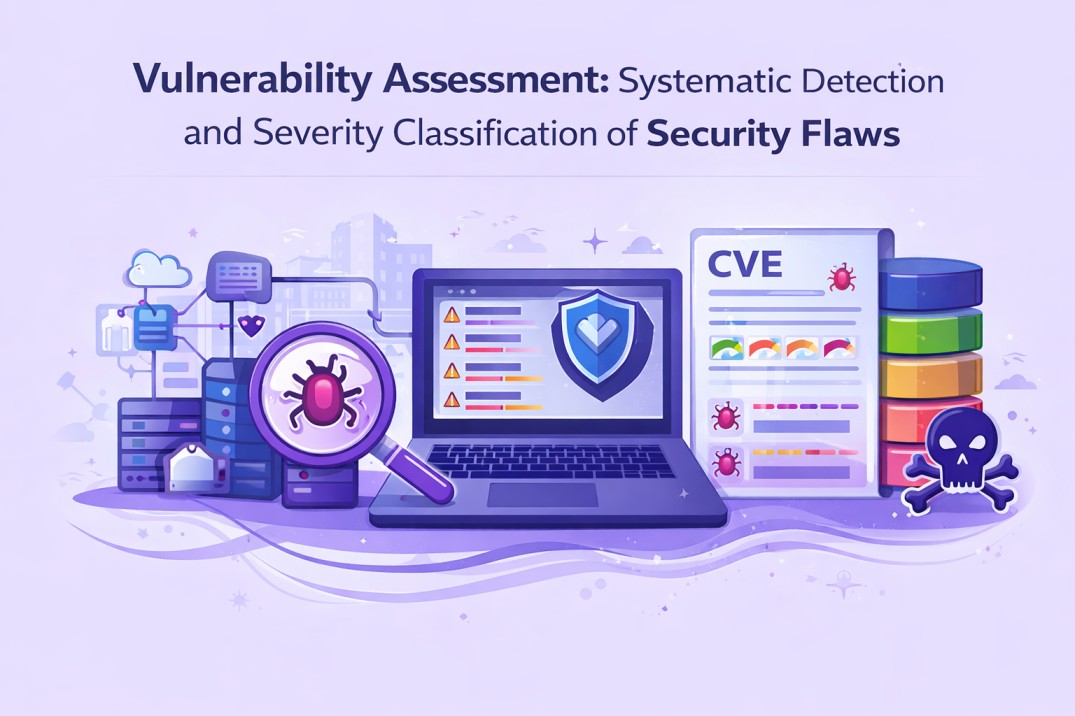
Vulnerability assessment is the structured process of identifying security flaws across network infrastructure, web applications, and cloud systems. It relies on vulnerability scanning and automated vulnerability detection to uncover weaknesses that could expose system assets.
A network vulnerability scan inspects exposed services, open ports, and configuration states. Application scanning evaluates authentication logic, input handling, and dependency risks. Findings are mapped against known records such as CVE (Common Vulnerabilities and Exposures) entries stored in global vulnerability databases.
Common issues include outdated software, missing patches, weak TLS configuration, and software misconfiguration. The objective is systematic discovery and structured severity classification, not random testing.
Automated Scanning Techniques Used to Detect Known Vulnerabilities
Modern vulnerability scanning tools rely on signature based detection and system fingerprinting to identify weaknesses.
Key techniques include:
Port scanning to detect open ports and exposed services
Software version enumeration to match installed versions against known CVEs
Configuration analysis to assess TLS configuration, patch levels, and firewall rules
System fingerprinting to identify operating systems and service behavior
For example, if a server exposes an outdated web service on a known port, the scanner correlates that version with vulnerability databases. If a matching CVE exists, it flags potential exposure.
These methods allow fast, broad coverage across large environments.
How Vulnerabilities Are Classified Using Severity Scoring Frameworks? (Including CVSS)
Detection alone does not indicate priority. Severity classification determines risk level.
The Common Vulnerability Scoring System assigns a numerical value based on:
Base score, which measures intrinsic exploitability and impact
Temporal score, which reflects exploit availability and patch maturity
Environmental score, which adjusts severity based on business context
A CVSS score explained in simple terms: it estimates how easily a flaw can be exploited and what damage it may cause. Exploitability score evaluates attack complexity and required privileges. Impact score measures confidentiality, integrity, and availability impact.
Severity levels typically range from Low to Critical. Classification supports risk based remediation rather than reactive patching.
Limitations of Automated Scanning and the Problem of False Positives
Automated vulnerability detection has practical limits.
False positives in vulnerability scanning occur when tools report issues that are not exploitable in the real environment. False negatives arise when a weakness exists but is not detected due to configuration variance or limited scan visibility.
Scan accuracy limitations often stem from:
Misidentified vulnerabilities due to version assumptions
Security misinterpretation of custom configurations
Incomplete authentication during application scanning
Detection indicates potential exposure. It does not confirm real attack feasibility. Speed is the issue: VulnCheck reports 32.1% of exploited CVEs in 1H-2025 had exploitation evidence on or before CVE issuance, so teams need validation and prioritization, not just scan output. Manual validation is required to eliminate false positives and verify whether a vulnerability can be exploited under runtime conditions.
Vulnerability assessment identifies possible risk. Confirmation requires deeper technical testing.
Penetration Testing: Controlled Exploitation to Confirm Real World Attack Feasibility

Penetration testing is the phase where identified vulnerabilities are actively tested under controlled conditions. It follows a defined penetration testing methodology that focuses on exploit validation, not disruption.
Security professionals simulate realistic attack techniques to determine whether a weakness can be used to gain unauthorized access. The process mirrors how threat actors operate, but within an authorized and monitored environment. Ethical hacking principles guide every step.
The objective is clear. Confirm whether a vulnerability leads to privilege escalation, lateral movement, or security control bypass. If exploitation is not possible, the risk is reclassified. If exploitation succeeds, the exposure is documented with evidence.
Penetration testing transforms theoretical findings into verified attack paths.
Manual Exploitation Techniques Used to Validate Vulnerability Impact
Manual testing confirms whether vulnerabilities are practically exploitable.
Common techniques include:
Proof of concept exploit development to demonstrate impact
Authentication bypass testing to evaluate access control strength
Injection attack validation against input fields and APIs
Examples include SQL injection to extract database records, cross-site scripting to manipulate session context, command injection to execute system-level actions, and session hijacking to assume user identity.
Each technique is executed in a controlled manner. The goal is validation, not damage. Evidence collected during testing proves whether the vulnerability can compromise confidentiality, integrity, or availability.
Multi Step Attack Chains and Privilege Escalation Simulation
Real world attacks rarely rely on a single flaw. Penetration testing evaluates chained attack scenarios.
A low-severity weakness may provide initial access. Credential harvesting can then expose access tokens or password hashes. Internal network pivoting may follow, allowing movement between systems. Privilege abuse may ultimately grant administrative control.
Lateral movement simulation tests how far an attacker could progress after initial compromise. The focus remains on understanding attack vectors across connected systems.
Evaluating multi step exploitation provides a realistic measure of exposure across the environment.
Legal Authorization and Scope Definition in Penetration Testing Engagements
Penetration testing requires explicit written authorization before any activity begins.
Each engagement defines rules of engagement, authorized testing scope, and scope limitation. Assets outside the agreed boundaries remain untouched. A defined testing window ensures operations do not interfere with business continuity.
Without formal approval and clear testing boundaries, active exploitation is unlawful. Proper authorization protects both the organization and the security team while maintaining ethical standards.
The Complete VAPT Workflow: Asset Enumeration, Vulnerability Discovery, Exploitation, and Risk Reporting
A reliable VAPT engagement follows a defined sequence. Each step builds on verified technical evidence. The purpose is not to produce scan output. The purpose is to confirm real exposure and document risk with precision.
The workflow consists of four core stages.
Pre Testing Asset Identification and Attack Surface Mapping
Every engagement begins with asset inventory validation. Security teams identify all in scope system assets. That includes servers, applications, APIs, network devices, databases, and identity systems.
Attack surface mapping then identifies reachable entry points such as:
Public and internal IP addresses
Exposed services and listening ports
Web login panels and admin interfaces
APIs and integration endpoints
Identity access management systems
If an asset is not identified, it cannot be tested. Incomplete enumeration leads to blind spots. A forgotten staging server or exposed management port often becomes the weakest link.
Accurate asset visibility defines the integrity of the entire assessment.
Vulnerability Discovery and Initial Technical Analysis
Once assets are mapped, vulnerability discovery begins.
Automated scanning identifies known weaknesses across operating systems, applications, and network services. Configuration review evaluates firewall rules, access controls, encryption settings, and patch levels.
Each finding is correlated with known CVE records from trusted vulnerability databases. That correlation confirms whether a weakness matches documented security flaws.
At this stage, risk remains potential. A detected vulnerability indicates possible exposure. It does not confirm exploitability.
Initial technical analysis evaluates location, accessibility, and control strength before moving to validation.
Exploitation and False-Positive Elimination Through Manual Validation
Manual validation determines whether a vulnerability can be exploited under real conditions.
Security professionals attempt controlled exploitation within the authorized scope. A confirmed exploit demonstrates practical exposure. Failed exploitation may indicate compensating controls or environmental protections.
Attack path validation assesses how weaknesses connect. A minor misconfiguration can become critical if it enables privilege escalation or access to sensitive systems.
Impact verification documents what an attacker could access, modify, or extract. Evidence replaces assumptions at this stage.
Manual validation removes false positives and prevents inflated risk reporting.
Reporting Structure and Risk Prioritization Logic
The final phase converts technical findings into structured risk documentation.
A professional vulnerability report includes:
Executive summary outlining overall exposure
Detailed technical findings with supporting evidence
Confirmed exploit scenarios
Clear remediation recommendations
Risk prioritization is based on exploitability, impact, and business context. A vulnerability exposed to the internet may rank higher than a similar issue in an isolated internal environment.
Effective reporting connects technical detail with decision-making. It enables leadership and security teams to act based on validated risk rather than raw scan data.
VAPT Methodologies and Industry Standards
Credible VAPT engagements align with established security frameworks. Methodology matters because it ensures consistency, scope control, and defensible reporting.
Commonly referenced standards include:
OWASP Testing Guide, which defines structured testing for web applications and APIs
NIST SP 800-115, which outlines technical guidance for security testing and assessment
PTES (Penetration Testing Execution Standard), which formalizes engagement phases and reporting structure
ISO 27001 control validation, where VAPT supports verification of implemented security controls
Scope Variations in VAPT Across Networks, Applications, and Cloud Environments
VAPT does not follow a single fixed scope. The assets under review determine the approach, tools, and depth of testing. A network focused engagement differs from web application penetration testing or cloud security testing.
Organizations often operate across internal networks, external networks, APIs, and identity management systems. Each environment presents distinct exposure paths. A public facing web application may face external threat actors. An internal network may face lateral movement after initial compromise.
Understanding scope diversity ensures that testing reflects real-world risk rather than partial visibility.
Network Infrastructure Testing (Internal and External)
Network penetration testing evaluates how attackers could access or move within network infrastructure.
External testing focuses on internet-facing systems. Internal testing assumes an attacker already gained limited access. Both perspectives matter.
Core activities include:
Firewall testing to verify rule enforcement
Router configuration review to assess segmentation
Identification of exposed services and intrusion exposure points
Validation of trust relationships between systems
For example, weak segmentation inside an internal network can allow rapid privilege escalation. External exposure may reveal unnecessary open ports. Both scenarios require different defensive controls.
Web Application and API Security Testing
Web application penetration testing targets logic flaws and input handling weaknesses. APIs receive similar scrutiny because they often expose sensitive data and business functions.
Testing commonly evaluates risks aligned with the OWASP Top 10, including:
Input validation testing to detect injection risks
Authentication flaws such as weak session controls
Authorization bypass in API endpoints
Improper error handling that reveals system details
An application may pass a network scan yet remain vulnerable to SQL injection or cross-site scripting. Application-layer weaknesses often bypass perimeter defenses.
Cloud Configuration and Identity Control Assessment
Cloud security testing focuses on configuration integrity and identity governance.
Common assessment areas include:
Storage bucket misconfiguration that exposes data publicly
IAM policies that grant excessive permissions
Access control testing for role-based privileges
Exposure of management interfaces
Cloud environments rely heavily on identity management systems. Misconfigured access controls often create broader exposure than traditional network flaws. A single overly permissive role can affect multiple services.
Security in the cloud depends more on configuration discipline than hardware boundaries.
Black Box, Gray Box, and White Box Testing Methodologies
Testing depth also varies based on knowledge level provided to the security team.
Black box testing simulates an external attacker with no prior knowledge. It evaluates exposure from an outsider’s perspective.
Gray box testing provides limited credentials or architectural insight. It reflects scenarios where attackers gain partial access.
White box testing offers full visibility, including architecture details and credentialed scans. It supports deeper validation of internal controls and logic paths.
Method selection depends on risk objectives. Each methodology answers a different question about exposure across the environment.
How Risk Severity Is Interpreted in VAPT Reports?
A VAPT report does more than list vulnerabilities. It explains how risk should be interpreted. Many reports fail here. They present CVSS scores without explaining real exposure.
Risk severity depends on two core factors: exploitability and impact.
Exploitability measures how easily a weakness can be used. Impact measures what happens after exploitation. A flaw that is easy to exploit but affects a low-value system may rank lower than a harder exploit that exposes sensitive data.
Risk scoring models combine these elements. CVSS calculation provides a technical base score. That score reflects exploit complexity, required privileges, and confidentiality, integrity, and availability impact.
A risk matrix then maps likelihood versus severity. Business impact analysis adjusts technical scoring based on operational importance. A medium CVSS score on a production payment system may outrank a higher score on a non-critical internal server.
Strong VAPT reporting connects technical scoring with business context.
Understanding the Difference Between Theoretical and Exploitable Vulnerabilities
Not every detected vulnerability creates practical exposure.
A theoretical vulnerability exists when a weakness matches a known CVE or misconfiguration pattern. A confirmed attack vector exists when exploitation succeeds under real conditions.
A validated exploit demonstrates practical exposure. Evidence may include access to restricted data, privilege escalation, or command execution within scope.
Without validation, severity remains estimated. After validation, severity reflects confirmed attack feasibility.
Distinguishing between potential and proven risk prevents inflated reporting and supports accurate remediation decisions.
Remediation Prioritization Based on Technical and Business Impact
Remediation prioritization should not rely on CVSS score alone.
Security teams must evaluate:
Technical exploitability
Business impact
Asset exposure level
Ease of patch deployment
Patch management addresses vulnerabilities through updates. Mitigation controls such as access restrictions or configuration changes may reduce risk when immediate patching is not possible.
Remediation sequencing ensures critical exposures are resolved first. Public-facing systems and identity platforms often require priority over isolated development environments.
Effective prioritization aligns technical severity with operational reality.
Retesting and Validation After Remediation
Remediation does not conclude the VAPT lifecycle. Validation confirms whether corrective actions eliminated the risk.
Retesting may take two forms:
Targeted retesting of specific vulnerabilities
Full reassessment of previously tested systems
Patch deployment alone does not guarantee resolution. Configuration drift or incomplete mitigation may leave residual exposure.
Validation verifies:
Exploit path closure
Correct patch application
Removal of misconfigurations
Without retesting, organizations rely on assumption rather than evidence.
Common Misconceptions About VAPT and Its Role in Cybersecurity
VAPT is often misunderstood. Many organizations treat it as a checkbox exercise or confuse it with other security activities. Clear boundaries matter.
Vulnerability scanning versus penetration testing is the first misconception. Scanning identifies known weaknesses through automated tools. Penetration testing validates whether those weaknesses can be exploited under real conditions. One detects potential exposure. The other confirms practical risk.
VAPT versus security audit is another common confusion. A compliance requirement verifies alignment with policies and regulatory frameworks. An audit checks documentation and control presence. VAPT evaluates whether those controls resist active attack. Passing an audit does not confirm resilience.
VAPT versus the red team also differs in purpose. A red team simulates advanced adversaries across broader objectives, often testing detection and response capabilities. VAPT focuses on structured vulnerability identification and exploit validation to measure security posture at a technical level.
Understanding these distinctions prevents misplaced confidence and supports informed security decisions.
Why VAPT Is Not a One Time Security Guarantee?
Security environments evolve. Systems change. Software updates introduce new code. Infrastructure expands.
Periodic testing is necessary because risk does not remain static. A system that was secure six months ago may now expose new services or outdated components.
Evolving threats alter attack techniques. New vulnerabilities appear regularly. Continuous validation ensures that defensive controls adapt to changes in the threat landscape.
Mandiant’s M Trends 2025 reports exploits as the top initial infection vector (33%), which is exactly why periodic VAPT beats one-time testing.
VAPT should be integrated into ongoing risk management rather than treated as a single event.
Why Compliance Testing Does Not Automatically Equal Security Effectiveness?
Meeting regulatory frameworks does not guarantee strong security.
Compliance focuses on predefined requirements. Checkbox security aims to satisfy audit criteria. Risk-based security evaluates real exposure across live systems.
An organization may pass compliance checks while critical vulnerabilities remain exploitable. Documentation may reflect policy alignment, yet practical defenses may fail under attack simulation.
Security effectiveness depends on validated control performance. VAPT measures operational resilience, not just policy adherence.
VAPT vs Continuous Monitoring
VAPT and continuous monitoring serve different functions within cybersecurity operations.
VAPT provides point in time validation of exploitability. It tests whether weaknesses can be leveraged under realistic conditions.
Continuous monitoring focuses on real-time detection. It tracks suspicious activity, policy violations, and anomalous behavior across systems.
Both are necessary. Monitoring detects active threats. VAPT evaluates whether defensive controls can prevent successful compromise.
An organization with strong monitoring but weak validation may detect attacks late. An organization with testing but no monitoring may miss live incidents.
Security maturity requires both proactive testing and ongoing detection.
The Role of VAPT Within an Ongoing Cybersecurity Risk Management Strategy
VAPT is not a standalone activity. It operates inside the cybersecurity risk management lifecycle as a validation mechanism. Risk management identifies threats and critical assets. VAPT tests whether those threats can exploit real weaknesses.
Within a mature security program, VAPT supports multiple functions.
1. Positioning VAPT in the Risk Management Lifecycle
Risk management typically includes asset identification, threat modeling, control implementation, monitoring, and improvement. VAPT fits after controls are deployed.
It provides:
Technical validation of existing security controls
Evidence of practical risk exposure
Measurable confirmation of attack feasibility
Without validation, risk assumptions remain theoretical.
2. Integration With Vulnerability Management and Patch Management
Vulnerability management identifies and tracks weaknesses. Patch management applies fixes. VAPT strengthens both processes by confirming which vulnerabilities are exploitable.
VAPT results help teams:
Prioritize patches based on confirmed exposure
Identify ineffective mitigation controls
Refine remediation sequencing
Reduce unnecessary emergency patching
A high CVSS score does not always equal urgent risk. Confirmed exploitability does.
3. Strengthening Threat Modeling and Incident Response
Threat modeling predicts likely attack paths. VAPT validates whether those paths are technically viable.
Confirmed findings improve:
Detection rule tuning
Incident response playbooks
Access control hardening
Monitoring strategies
If lateral movement succeeds during testing, segmentation policies may require adjustment. If authentication bypass is validated, identity management controls need review.
4. Enabling Continuous Security Validation
Security environments change constantly. Infrastructure expands. Software updates introduce new code. Attack techniques evolve.
Continuous security validation ensures that defensive controls remain effective over time. Periodic VAPT engagements provide measurable checkpoints.
VAPT does not replace continuous monitoring. It strengthens it. Monitoring detects activity. VAPT tests whether that activity could succeed.
In a complete cybersecurity ecosystem, VAPT acts as a controlled reality check. It confirms whether risk controls perform under pressure, not just in documentation.
How Often Should VAPT Be Conducted?
VAPT frequency should be risk-driven rather than arbitrary. At minimum, organizations conduct annual baseline testing. Higher-risk environments require more frequent validation.
Additional triggers include:
Major infrastructure changes
Deployment of new web applications or APIs
Migration to cloud environments
Significant patch cycles affecting critical systems
Organizational changes such as mergers or acquisitions
Attack surfaces evolve over time. New integrations, new services, and new threat techniques alter exposure. Periodic reassessment ensures that security controls remain effective under current conditions.
Frequency should reflect asset criticality and threat exposure.
Frequently Asked Questions (FAQs)
What is the difference between vulnerability assessment and penetration testing?
Vulnerability assessment identifies known security weaknesses. Penetration testing confirms whether those weaknesses can be exploited. One detects potential risk. The other validates real attack feasibility.
Is VAPT mandatory?
VAPT is not universally mandatory, but many regulatory frameworks such as PCI DSS and ISO 27001 require periodic security testing. Even when not required, organizations conduct VAPT to reduce breach risk.
How often should VAPT be performed?
Most organizations conduct VAPT annually. Higher-risk environments may require testing after major infrastructure changes, application deployments, or security incidents.
How long does a VAPT engagement take?
Duration depends on scope and complexity. A small application may take one to two weeks. Enterprise environments may require several weeks for full validation and reporting.
What does a VAPT report include?
A VAPT report includes an executive summary, detailed findings, severity ratings, confirmed exploit evidence, and remediation recommendations. It prioritizes risk based on impact and exploitability.
Does VAPT guarantee complete security?
No. VAPT provides point in time validation of exploitable weaknesses. Ongoing monitoring, patch management, and periodic reassessment remain necessary.
Who should conduct VAPT?
Qualified cybersecurity professionals with expertise in network and application security should conduct VAPT. Independent testing improves objectivity and accuracy.
What tools are used in VAPT?
VAPT uses automated vulnerability scanners, network mapping tools, and web application testing tools. Manual validation confirms exploitability beyond automated detection.