

API Schema Validation and Fuzzing: How to Catch the Vulnerabilities That Standard API Testing Leaves Behind
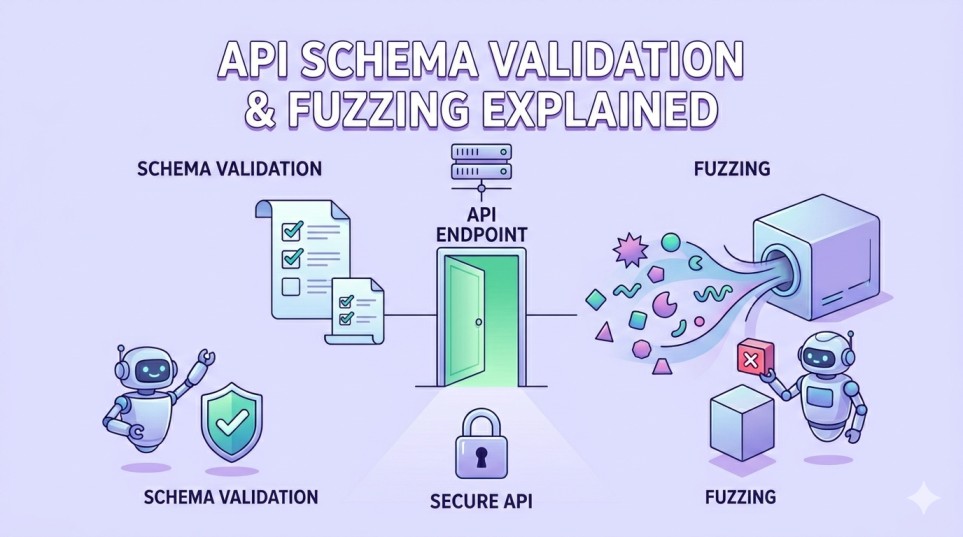
Modern APIs expose critical data, power business workflows, and connect multiple services across distributed systems. Even a single weak endpoint can open the door to serious risks such as data exposure, privilege escalation, or service disruption.
As APIs grow in complexity, relying only on basic testing or authentication controls is no longer sufficient. Two techniques play a key role in strengthening API security: schema validation and fuzz testing. Schema validation ensures that every request and response follows a clearly defined structure, preventing malformed or unexpected data from entering the system.
Fuzzing takes a different approach by deliberately sending unusual, invalid, or boundary-case inputs to observe how the API behaves under stress. While validation focuses on enforcing correctness, fuzzing focuses on uncovering weaknesses that appear only under abnormal conditions.
When used together, they provide a more complete view of API security by identifying both obvious issues and subtle vulnerabilities that traditional testing often misses.
What API Schema Validation and Fuzzing Mean in Modern API Security?
API Schema Validation Defined
API schema validation checks whether incoming requests and outgoing responses follow a clearly defined contract between the client and the server, making it a foundational practice in modern API Security Testing. That contract is typically described using standards such as OpenAPI Specification and JSON Schema, which define the expected structure, data types, formats, and constraints for each API endpoint.
For example, a schema can specify required fields, enforce that an email follows a valid format, or limit a numeric value within a specific range. During validation, the API compares actual traffic against this definition and rejects anything that does not comply.
This process ensures consistency across services, reduces the risk of malformed data entering business logic, and helps developers detect integration issues early. In practice, schema validation acts as a guardrail that keeps API interactions predictable, reliable, and easier to maintain across different environments.
Validation typically enforces:
Required fields
Data types
Allowed formats such as email or UUID
Constraints such as min and max values
Example:
A schema defines age as an integer between 0 and 120.
A request with "age": "twenty" or "age": 500 should fail immediately.
That early rejection prevents malformed data from reaching business logic.
Schema validation improves:
Data integrity
Predictable API behavior
Protection against malformed input
It does not guarantee security. It only ensures that inputs look correct.
API Fuzzing Explained
API fuzzing sends unexpected inputs to observe how a system behaves under conditions that normal testing does not cover.
Instead of using only valid and predictable requests, fuzzing introduces unusual data such as incorrect formats, extreme values, oversized payloads, or unexpected parameter combinations. The goal is to see how the API handles stress, errors, and edge cases.
A well built API should respond safely with controlled errors, while a weak one may crash, leak information, or behave unpredictably.
For example, sending very large numbers, invalid JSON structures, or altered object IDs can reveal flaws in validation, parsing, or authorization logic. By exposing how the system reacts to abnormal input, fuzzing helps identify hidden vulnerabilities that standard functional tests often miss.
Instead of testing valid scenarios, it explores:
Invalid formats
Boundary values
Oversized payloads
Parameter combinations that normal tests ignore
Two practical approaches:
1. Mutation based fuzzing
Takes a valid request and alters it slightly
Example
price=100 becomes price=-1 or price=999999
2. Generation-based fuzzing
Creates requests from API schemas
Then introduces controlled variations
Fuzzing reveals:
Crashes
Improper error handling
Hidden assumptions in codeSecurity weaknesses
A simple analogy helps. Schema validation checks if a key fits the lock. Fuzzing tests what happens when someone tries every possible variation of that key.
Why Schema Validation and Fuzzing Must Work Together?
Schema validation ensures that API inputs follow predefined rules such as data types, required fields, formats, and value constraints, which helps maintain consistency and prevents clearly invalid data from entering the system. It acts as a strict gatekeeper that allows only well-formed requests to pass through.
Fuzzing, on the other hand, tests what happens when those rules are pushed to their limits or slightly bent, forming a critical layer of modern API Scanning. It introduces boundary values, unexpected combinations, and unusual but sometimes still valid inputs to observe how the API behaves beyond normal conditions.
For example, even if a field allows values between 1 and 100, fuzzing may test edge values like 0, 100, 101, or very large numbers to uncover hidden issues.
Together, schema validation establishes control, while fuzzing challenges that control to ensure the system remains stable, secure, and predictable under real-world conditions.
Validation alone misses:
Valid inputs used in harmful ways
Authorization flaws
Logical errors in workflows
Combined approach provides:
Controlled input validation
Exploration of edge cases
Better coverage of API behavior
For example, a request may pass schema validation but still expose another user’s data when IDs are manipulated. Only fuzzing reveals that.
Where Schema Validation Fits in the API Lifecycle?
Design-Time Validation in Development
Schema validation should start at design stage.
In a schema-first approach:
API contracts are defined before coding
Developers follow strict data rules
Inconsistencies are caught early
In CI/CD pipelines:
Contract tests verify request and response formats
Builds fail if schema rules are violated
That reduces production defects and improves API reliability.
Runtime Validation at API Gateways
API gateways enforce validation during live traffic.
Common platforms:
Kong
Apigee
AWS API Gateway
Gateways block:
Invalid payloads
Missing required fields
Incorrect data types
Example:
A login endpoint expects a valid email format. Gateway rejects malformed emails before they reach backend logic.
This reduces unnecessary load and limits attack surface.
Limitations of Schema Validation Alone
Schema validation checks structure, not intent.
A request can be valid and still harmful.
Examples:
Accessing another user’s data using a valid ID
Repeating valid requests in a harmful sequence
Sending correct data that triggers logic flaws
Schema validation does not detect:
Broken Object Level Authorization
Business logic abuse
Workflow manipulation
These issues require behavior-based testing, which is where fuzzing helps.
Deep Dive into API Fuzzing Methodologies
API fuzzing techniques vary in how they generate inputs, but all aim to uncover how an API behaves beyond normal usage. Different methods provide different levels of depth and efficiency, and understanding them helps teams choose the right approach for their testing strategy.
Some techniques focus on modifying real traffic, while others rely on structured definitions like OpenAPI to generate test cases. More advanced approaches go a step further by learning from system responses and adapting tests over time, including how APIs handle API Authentication under unexpected or edge-case conditions.
Using a combination of these methods allows teams to move from basic input testing to deeper exploration of application behavior, improving the chances of finding subtle bugs and security weaknesses that standard testing often misses.
Mutation Based Fuzzing
Mutation-based fuzzing alters real requests.
Typical variations:
Boundary values such as 0, negative, or large numbers
Special characters in text fields
Header manipulation
Parameter tampering
Example:
A quantity field expected between 1 and 100 is tested with:
0
101
very large numbers
These cases reveal validation gaps and error handling issues.
Generation Based Fuzzing
Generation-based fuzzing uses API schemas.
Tools read OpenAPI definitions and generate requests automatically.
Then they test variations such as:
Missing fields
Maximum allowed sizes
Slightly invalid values
Example:
If a string field allows 50 characters, fuzzing tests 49, 50, and 51 characters.
This approach provides structured and repeatable testing.
Intelligent and Coverage-Guided Fuzzing
Advanced fuzzing adapts based on system feedback.
It analyzes:
Response codes
Error messages
Execution paths
Then it focuses on unexplored areas.
Benefits:
Better efficiency
Deeper testing
Reduced redundant requests
It moves from random testing to targeted exploration.
Real World Vulnerabilities Found Through Fuzzing and Validation Gaps
APIs often appear secure when inputs match expected formats, but real vulnerabilities tend to surface when those inputs are tested beyond normal conditions.
Many critical security issues do not come from obviously invalid data, but from inputs that are technically valid yet behave differently during processing.
Fuzzing plays a key role here by exposing how APIs handle unexpected variations, boundary cases, and subtle manipulations. It helps uncover weaknesses in input handling, authorization logic, and parsing behavior that standard validation does not detect.
Even when schema validation is in place, attackers can exploit gaps using encoding tricks, parameter manipulation, or edge case inputs. The following examples highlight common vulnerabilities that fuzzing can reveal in real-world API implementations.
Injection and Input Handling Issues
Fuzzing often reveals injection points.
Examples:
SQL injection through unexpected characters
Command injection via parameters
Parsing failures in JSON
Even with schema validation, encoding tricks can bypass filters.
Broken Object Level Authorization
BOLA is one of the most common API risks.
It occurs when users can access objects they should not.
Fuzzing identifies this by:
Changing object IDs
Enumerating resources
Testing access patterns
Example:
/orders/1001 becomes /orders/1002
If data is exposed, authorization is broken.
Schema validation does not prevent this because the request format remains valid.
Schema Bypass and Edge Case Exploits
Some inputs behave differently after parsing.
Examples:
Unicode variations
Null byte injections
Duplicate parameters
Fuzzing exposes these inconsistencies.
Systems may accept inputs that pass validation but behave unexpectedly during execution.
Integrating Schema Validation and Fuzzing into CI/CD Pipelines
Integrating schema validation and fuzz testing into CI/CD pipelines ensures API security is not treated as a one-time activity but as a continuous process.
As APIs evolve with new features and updates, validation and testing must keep pace to catch issues early and prevent regressions. Automated schema validation enforces contract consistency in every build, while fuzz testing adds a layer of behavioral testing that uncovers deeper vulnerabilities.
Running both in the pipeline helps teams identify problems before deployment rather than after incidents occur. At the same time, testing must be balanced with performance to avoid slowing development cycles. A structured approach that prioritizes critical endpoints and uses targeted testing ensures strong coverage without unnecessary overhead.
Automated Schema Validation in Pipelines
Schema validation should run in every build cycle.
Typical setup:
Validate API contracts during testing
Fail builds on violations
Use tools such as Postman or Newman
This ensures consistent API behavior across environments.
Continuous Fuzz Testing Strategies
Fuzzing should run regularly, not just once.
Best approach:
Test in staging environments
Schedule periodic scans
Focus on critical endpoints
High priority areas:
Authentication
Payments
Data access
Balancing Coverage and Performance
Fuzzing can consume resources.
To optimize:
Focus on high-risk endpoints
Limit test duration
Use targeted test cases
The goal is meaningful coverage without slowing development.
Tools and Frameworks for API Schema Validation and Fuzzing
A strong API security strategy depends on using the right tools for both validation and testing. Schema validation tools help enforce API contracts and ensure that requests and responses remain consistent with defined specifications such as OpenAPI and JSON Schema.
Tools like Swagger Validator, Stoplight, and other OpenAPI validators are commonly used to detect mismatches early and maintain reliable API behavior across environments. On the other hand, API fuzzing tools such as Burp Suite, OWASP ZAP, and Schemathesis focus on actively testing APIs with unexpected inputs to uncover hidden vulnerabilities.
These tools support automated fuzzing, payload variation, and structured security testing workflows that form the foundation of a consistent API Methodology. Using either approach alone provides limited coverage.
Combining schema validation with fuzzing creates a more complete testing strategy that verifies correctness while also testing resilience, leading to better coverage, stronger security assurance, and continuous validation of API behavior.
Schema Validation Tools
Common tools:
Swagger Validator
Stoplight
OpenAPI validators
They ensure API responses match defined contracts.
API Fuzzing Tools
Widely used tools:
Burp Suite
OWASP ZAP
Schemathesis
They support:
Automated fuzzing
Payload variation
Security testing workflows
Combining Tools for Maximum Coverage
Best practice is to combine both approaches. Validation ensures correctness. Fuzzing tests resilience.
Together they provide:
Better coverage
Higher confidence in security
Continuous validation of API behavior
Best Practices for Implementing Schema Validation and Fuzzing
Building secure APIs requires more than isolated testing. It starts with well-defined schemas, continues with focused fuzzing, and improves through continuous feedback. Each of these practices strengthens a different layer of API security.
Strong schemas reduce the chance of malformed or ambiguous data entering the system. Targeted fuzzing exposes weaknesses in critical areas where real attacks are likely to occur. Monitoring and feedback ensure that insights from testing and production behavior are not lost but used to improve the system over time.
When these practices are applied together, API security becomes a continuous and adaptive process rather than a one-time effort.
Design Secure API Schemas
Strong schemas reduce risk.
Key practices:
Use strict data types
Define clear constraints
Avoid flexible or undefined fields
Create Effective Fuzzing Strategies
Focus on areas that matter most.
Prioritize:
Sensitive endpoints
Complex workflows
User controlled inputs
Map testing to real attack surfaces.
Use Monitoring and Feedback Loops
Track:
Failed requests
Error patterns
Anomalies
Feed results back into development.
Security improves when testing and monitoring are connected.
Future Trends in API Schema Validation and Fuzzing
API security is moving toward more adaptive and automated approaches as systems grow in scale and complexity. Traditional testing methods struggle to keep up with rapidly changing APIs, frequent deployments, and evolving attack patterns.
New techniques are emerging to make testing smarter, more continuous, and less dependent on manual effort. AI-driven fuzzing improves how inputs are generated and prioritized, while better schema management helps maintain consistency as APIs evolve.
At the same time, security testing is shifting toward automation that runs continuously within development pipelines. These trends aim to make API security more proactive, scalable, and aligned with modern DevSecOps practices.
AI Driven Fuzzing
AI improves input generation.
It helps:
Identify patterns faster
Focus on high-risk paths
Reduce manual effort
Schema Evolution and Versioning Challenges
APIs change over time.
Challenges include:
Maintaining compatibility
Updating validation rules
Preventing schema drift
Proper version control is essential.
Autonomous API Security Testing
Security testing is becoming continuous.
Future systems will:
Run tests automatically
Adapt to new threats
Integrate directly into pipelines
Want this tested on your own stack?
Pre-book a penetration test or SOC 2 / ISO 27001 readiness. No payment and no commitment.
 Questions about scoping?