

Network Penetration Testing Explained
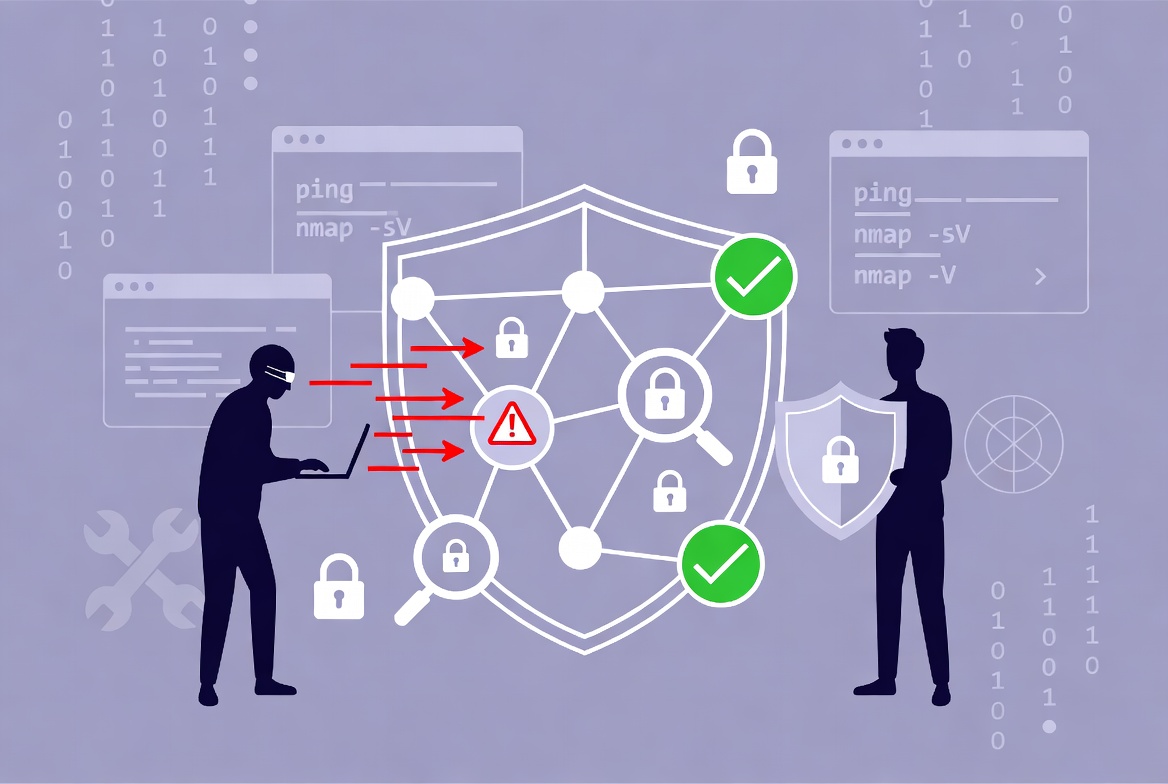
Network penetration testing goes beyond finding vulnerabilities. It tests whether those weaknesses can actually be exploited to compromise a network.
Automated scans often generate long lists of issues, but they rarely show real risk. A penetration test simulates how an attacker would gain access, move within the network, and reach critical systems.
For example, a minor misconfiguration might seem harmless on its own. In practice, it can become the first step in a chain that leads to full network control.
The purpose is simple. Identify real attack paths, prove impact, and help organizations fix what truly matters.
What Network Penetration Testing Really Means?
Most explanations stop at “ethical hacking to find vulnerabilities.” That view is incomplete and often misleading.
Network penetration testing is about validating real attack paths, not just identifying weaknesses. It answers a critical question: If an attacker targets your network, what can they actually achieve?
Security teams already have tools that detect issues. What they often lack is context. A penetration test connects isolated findings into a realistic breach scenario.
Penetration Testing vs Vulnerability Scanning vs Red Teaming
Vulnerability scanning uses automated tools to detect known issues such as outdated software, open ports, or weak configurations. Tools like Nessus generate large reports quickly, but results often include false positives and lack context.
Penetration testing goes deeper. It manually verifies whether vulnerabilities can be exploited. Testers chain multiple weaknesses together using frameworks like Metasploit to simulate real attacks.
Red teaming focuses on full adversary simulation. It tests detection and response capabilities, often without prior knowledge from defenders.
A common mistake is treating these as interchangeable. A vulnerability scan may show “what is wrong,” while a penetration test shows “what can actually be exploited.” Red teaming goes further by testing whether the organization can detect and stop the attack.
Core Objectives of Network Penetration Testing
Identify exploitable weaknesses: Focus is on vulnerabilities that attackers can realistically use, not theoretical risks.
Validate attack paths: Individual issues rarely cause breaches. Penetration testing shows how multiple weaknesses connect.
Measure real impact: Instead of listing severity scores, it demonstrates outcomes such as data access, system control, or lateral movement.
Organizations often rely on standards from OWASP, but penetration testing extends beyond checklists. It provides proof of risk, not assumptions.
Types of Network Penetration Testing
The effectiveness of a penetration test depends heavily on the scope. Without clear boundaries and assumptions, results can be misleading or incomplete.
Different testing types exist to simulate different attacker perspectives. Choosing the wrong type often leads to either shallow insights or unrealistic conclusions.
External vs Internal Network Testing
External testing focuses on assets exposed to the internet. This includes public IPs, VPN gateways, web servers, and firewalls. The goal is to identify entry points that an outside attacker could exploit.
Internal testing assumes the attacker already has access. That access could come from phishing, stolen credentials, or a compromised device. The test then evaluates how far the attacker can move inside the network.
For example, an external test may find a single exposed service. An internal test might reveal that once inside, an attacker can access sensitive servers due to weak segmentation.
Tools like Nmap are commonly used to map both external and internal environments, but the intent differs.
Black Box, White Box, and Gray Box Testing
Black box testing simulates an attacker with no prior knowledge. It is realistic but time intensive and may miss deeper issues due to limited visibility.
White box testing provides full access, including network diagrams, credentials, and configurations. It delivers deeper coverage but is less reflective of real attack conditions.
Gray box testing sits between both. It gives partial knowledge, balancing realism and efficiency.
Each approach has trade offs. Black box testing mirrors real attacks but may lack depth. White box testing uncovers more vulnerabilities but assumes insider level knowledge.
Organizations aligned with frameworks from EC-Council often use gray box testing for practical balance.
Automated vs Manual Penetration Testing
Automated testing uses tools to scan and detect known vulnerabilities quickly. Tools like OpenVAS help cover large environments efficiently.
Manual testing involves human analysis, creative thinking, and exploit chaining. It identifies complex attack paths that tools cannot detect.
Automation is useful for coverage. Manual testing is essential for accuracy.
For instance, a tool may flag weak credentials. A human tester can combine that with misconfigurations and privilege escalation to gain full control of the network.
The Complete Network Penetration Testing Methodology
Most articles list phases without explaining how attackers actually move through them. Real penetration testing is not linear. Each phase feeds the next, and findings are constantly re-evaluated.
A strong pentest methodology focuses on progression. Start with visibility, gain access, expand control, then prove impact.
Phase 1: Reconnaissance (Passive & Active Intelligence Gathering)
Identify target assets such as domains, IP ranges, and exposed services
Use passive techniques to avoid detection and active techniques for deeper insight
Build an initial map of the attack surface
Passive reconnaissance often involves tools like Shodan to discover publicly exposed systems. Active reconnaissance directly interacts with targets, which increases accuracy but also detection risk.
A weak start here limits everything that follows. Missed assets mean missed attack paths.
Phase 2: Scanning & Enumeration
Discover open ports, running services, and system versions
Enumerate users, shares, and configurations in protocols like SMB and SNMP
Identify potential entry points
Scanning tools and traffic analysis using Wireshark help reveal how systems communicate and where weaknesses exist.
Enumeration goes deeper than scanning. It extracts usable information such as usernames or system roles, which can be used in later attacks.
Phase 3: Exploitation (Gaining Initial Access)
Exploit vulnerabilities such as outdated software or weak configurations
Use credential attacks or misconfigurations to gain entry
Validate whether identified weaknesses are truly exploitable
Frameworks like Metasploit are commonly used to execute controlled exploits and test real-world scenarios.
The goal is not to exploit everything. Focus stays on proving that access is possible and identifying the most effective attack path.
Phase 4: Post Exploitation & Lateral Movement
Escalate privileges to gain higher level access
Move across systems to expand control within the network
Identify sensitive data and critical systems
This phase demonstrates real impact. Many breaches occur not at entry, but during lateral movement due to weak segmentation and excessive permissions.
Phase 5: Reporting & Remediation Strategy
Document findings with clear evidence and impact
Prioritize vulnerabilities based on real risk, not just severity scores
Provide actionable remediation steps
Scoring systems like CVSS help classify severity, but real world impact often differs. A medium rated issue can become critical when combined with others.
Effective reporting bridges the gap between technical details and business decisions.
Tools Used in Network Penetration Testing (And When They Matter)
Tools play a critical role in penetration testing, but they are often misunderstood. Many assume tools perform the test. In reality, tools assist. The tester drives the logic, decisions, and attack paths.
Strong testing depends on selecting the right tools at the right stage, not using as many as possible.
Core Tool Categories
Network scanning tools: Used to discover hosts, ports, and services. Tools like Nmap help build the initial network map.
Vulnerability scanners: Identify known weaknesses across systems. Nessus is widely used for fast detection, though results require validation.
Exploitation frameworks: Enable controlled exploitation of vulnerabilities. Metasploit helps simulate real attack scenarios.
Traffic analysis tools: Capture and inspect network data. Wireshark is used to analyze communication patterns and identify sensitive data exposure.
Web and application testing tools: Even in network tests, web interfaces are common entry points. Burp Suite helps identify authentication and input-related flaws.
Each category supports a specific phase in the methodology. No single tool covers the entire process.
Tool Limitations and False Confidence
Tools detect patterns, not context
High number of false positives and false negatives
Inability to identify complex attack chains
For example, a scanner may flag a vulnerability but cannot determine if it leads to privilege escalation or lateral movement. That requires human analysis.
Over-reliance on tools creates a false sense of security. Organizations may believe they are protected because reports look comprehensive, even when critical attack paths remain untested.
Even advanced tools like Nessus cannot replicate human reasoning or adapt to unique environments.
Real World Attack Scenarios Simulated in Network Pentesting
A penetration test has little value if it only lists isolated vulnerabilities. Real attackers do not think in terms of individual flaws. They follow paths.
Network penetration testing focuses on simulating those paths. It connects weaknesses across systems to show how a breach can actually happen.
Common Network Attack Paths
External entry → internal compromise: An exposed service or weak VPN configuration allows initial access. From there, the attacker explores the internal network.
Credential-based attacks: Weak or reused passwords enable access without exploiting software vulnerabilities.
Misconfiguration chaining: Small issues like open shares or excessive permissions combine into larger risks.
Frameworks like MITRE ATT&CK help map these actions into structured attack techniques. They show how attackers move from initial access to full control.
A typical path may look simple at first. Gain access to one machine, extract credentials, then access more critical systems. Each step builds on the previous one.
Case Study Breakdown (End to End Attack Simulation)
Step by step progression from entry to impact
How multiple vulnerabilities combine into one attack path
Clear demonstration of business risk
A simplified scenario:
An attacker discovers an exposed service during reconnaissance
A known vulnerability provides initial access
Credentials are extracted using tools and misconfigurations
Privilege escalation grants administrative control
Sensitive systems and data become accessible
Training organizations like SANS Institute often use similar structured scenarios to teach real world attack flow.
The key insight is not the individual vulnerability. The risk comes from how easily those vulnerabilities connect.
Business Value of Network Penetration Testing
Many organizations run penetration tests to meet requirements. Few use them to reduce real risk.
The value of network penetration testing is not in the report itself. It lies in how clearly it shows what could actually go wrong and what needs to be fixed first.
Why Compliance Driven Testing Fails?
Focus on passing audits instead of improving security
Limited scope defined by standards rather than real threats
Lack of depth in testing and validation
Standards like PCI DSS often require periodic testing. In many cases, organizations aim to meet the minimum requirement.
That approach creates blind spots. A test designed only for compliance may ignore critical systems, realistic attack paths, or post-exploitation impact.
Security becomes a checklist exercise instead of a risk-driven process.
Measuring ROI of Penetration Testing
Focus on risk reduction, not number of vulnerabilities found
Prioritize fixes based on potential impact
Compare cost of testing with potential breach impact
Return is not measured by how many issues are discovered. It is measured by how effectively critical risks are identified and reduced.
A single validated attack path that leads to sensitive data exposure has more value than hundreds of low-risk findings.
Using basic business concepts like Return on Investment helps shift the focus from technical output to strategic value.
For example, fixing one critical misconfiguration identified during testing may prevent a breach that could cost far more than the test itself.
Common Mistakes in Network Penetration Testing
Even well intentioned penetration tests can fail to deliver meaningful insights. Understanding common mistakes helps organizations get real value from their testing.
Shallow Testing & Tool Dependency
Relying solely on automated tools without human analysis
Missing complex attack chains that require creative thinking
Generating long reports with little actionable insight
Many organizations stop after running scanners like Nessus. While these reports look comprehensive, they often miss how vulnerabilities combine in real attacks.
Lack of Business Context
Failing to prioritize vulnerabilities based on impact
Ignoring which assets are most critical to operations
Producing reports that are technical but not actionable
Technical findings without a business context limit decision-making. For example, exploiting a minor test server may be easy, but it does not represent real business risk.
Ignoring Post Exploitation Impact
Overlooking lateral movement, privilege escalation, and persistence
Reporting only entry points without demonstrating real impact
Misjudging the severity of vulnerabilities
Organizations often stop at “we found an open port” rather than showing how it could lead to full compromise. Real insight comes from proving the attack path and potential consequences.
How to Choose the Right Network Penetration Testing Approach?
Selecting the right testing approach is critical to getting meaningful results. The choice affects scope, methodology, depth, and ultimately business risk reduction.
In House vs Third Party Testing
In-house teams may have deep knowledge of internal systems but risk bias and blind spots.
Third-party testers provide fresh perspectives, simulate external attackers more realistically, and bring expertise in multiple frameworks.
Combining both approaches can balance familiarity and objectivity.
Frequency and Timing of Tests
Regular testing is necessary as networks evolve.
Critical changes, like new applications, cloud migrations, or infrastructure updates, require ad-hoc testing.
Continuous monitoring or periodic testing schedules depend on risk appetite.
Defining Scope and Rules of Engagement
Clearly define systems, networks, and applications to test
Establish acceptable techniques, limits, and reporting requirements
Include goals aligned with business priorities
A well defined scope ensures the test is realistic, safe, and actionable. Standards like ISO provide frameworks for structuring rules of engagement.
Future Trends in Network Penetration Testing
Network penetration testing is evolving. Attackers innovate, and defenses must keep pace. Modern testing increasingly focuses on continuous validation, automation, and adaptive risk assessment.
AI Assisted Pentesting
AI can automate reconnaissance, pattern recognition, and exploit suggestions
Speeds up repetitive tasks, freeing testers to focus on complex attack chains
Still requires human oversight for context, creativity, and risk judgment
AI is not a replacement. It is an amplifier that enhances testing efficiency and accuracy.
Continuous Testing & Attack Surface Management
Networks and applications change constantly
Continuous testing ensures vulnerabilities are detected as environments evolve
Integrates with attack surface management to maintain an up-to-date security posture
Organizations no longer rely solely on periodic tests. Continuous validation identifies risks before attackers exploit them.
Zero Trust and Its Impact on Testing
Zero Trust assumes no implicit trust, enforcing strict access controls
Changes penetration testing focus from perimeter breaches to internal lateral movement and privilege escalation
Testing strategies adapt to evaluate segmentation, authentication, and micro-perimeters
The adoption of Zero Trust shifts attack scenarios. Testers focus on how easily attackers could bypass controls rather than simply gaining entry.
Want this tested on your own stack?
Pre-book a penetration test or SOC 2 / ISO 27001 readiness. No payment and no commitment.
 Questions about scoping?