

Beyond Traditional VAPT: 8 Modern Alternatives That Close the Gaps Periodic Testing Leaves Open
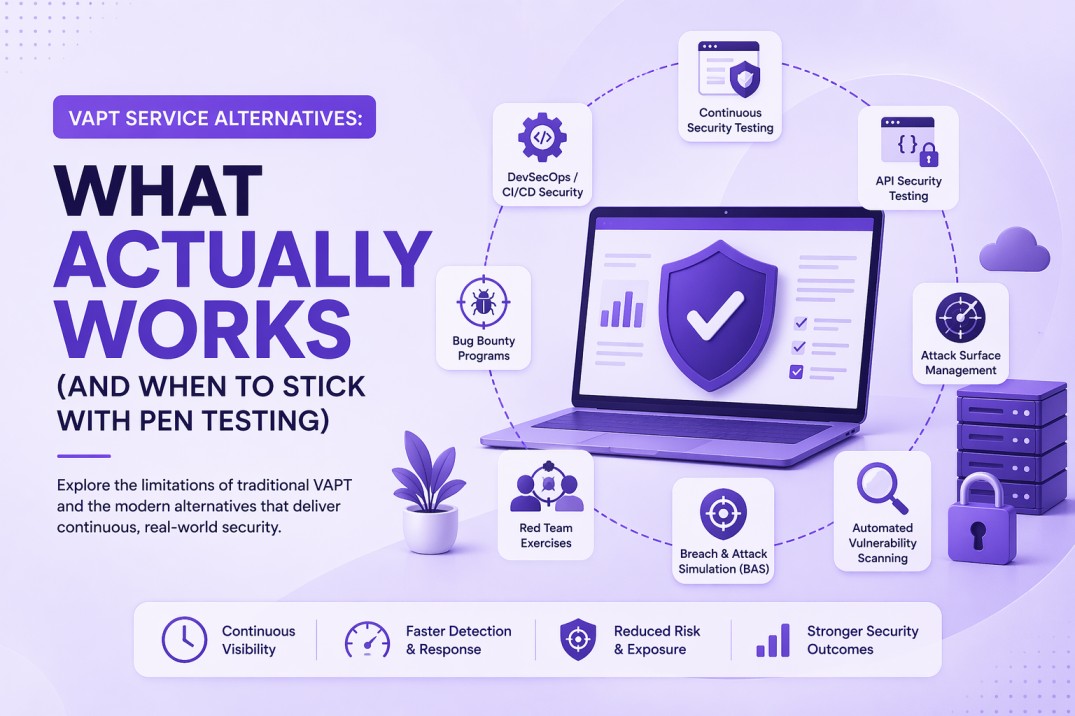
If you've been relying on periodic penetration testing alone to secure your infrastructure, you're already behind. The way modern applications are built, microservices, containerized workloads, API-first architectures, and continuous deployments, means your attack surface changes faster than any quarterly assessment can track.
That doesn't make vulnerability assessment and penetration testing obsolete. Far from it. But it does mean security teams need to understand what VAPT can and can't do, and which alternatives (or complements) actually close the gaps.
This guide breaks it all down: the real limitations of traditional testing, the best modern alternatives, and how to build a security strategy that holds up in fast-moving environments.
Why Organizations Are Looking Beyond Traditional VAPT?
According to the Verizon 2025 Data Breach Investigations Report, around 60% of breaches involve a human element such as social engineering, credential misuse, or errors. Meanwhile, the IBM Cost of a Data Breach Report 2024 found that organizations using AI and automation in security identified and contained breaches roughly 80 days faster than those without them.
The pattern is clear: the window between testing cycles is where attackers operate.
Traditional vulnerability assessment and pentesting methods were designed for environments that changed slowly. A yearly or quarterly engagement made sense when deployment cycles were measured in months. Today, engineering teams push code daily. A vulnerability introduced on a Tuesday might be exploited by Friday, long before your next scheduled engagement.
This isn't a flaw in VAPT itself. It's a mismatch between the methodology and the environment it's being applied to.
The Real Limitations of Traditional Penetration Testing
Understanding these limitations isn't about dismissing VAPT, it's about knowing exactly where it falls short so you can fill those gaps strategically.
1. Point in Time Visibility
A network penetration test or web application assessment captures your security posture on the day it's conducted. Any vulnerability introduced after the testers log off is invisible until the next engagement. In CI/CD environments, that could mean dozens of deployments go untested.
2. Limited Coverage of Modern Attack Surfaces
Traditional methodologies were built around monolithic web apps and network perimeters. Today's systems include:
Hundreds of API endpoints with complex auth flows
Ephemeral cloud resources that spin up and down dynamically
Third-party integrations that expand your attack surface without your direct involvement
Container orchestration layers with their own misconfiguration risks
A standard web application penetration test engagement may not adequately cover all of these areas unless it's specifically scoped and priced to do so.
3. Speed vs. Depth Trade Off
Manual testing is thorough, that's its biggest strength. But it's also slow. By the time a VAPT report lands in your inbox and remediation is prioritized, the development team may have shipped three more releases. The feedback loop is too long for modern delivery cadences.
4. Cost Structure Discourages Frequency
Most organizations can't afford to run comprehensive manual assessments every month. So they schedule them once or twice a year, which creates predictable windows of exposure that attackers can exploit.
5. Reactive by Design
Traditional testing finds vulnerabilities that already exist. It doesn't prevent them from being introduced. Without upstream security controls, you're playing a perpetual game of catch-up.
Top VAPT Alternatives (And What Each One Is Actually Good For)
None of these replace comprehensive penetration testing entirely. What they do is cover the gaps, providing continuous visibility, early detection, and scalability that manual engagements can't match.
1. Continuous Security Testing Platforms
These platforms automate vulnerability detection across applications and infrastructure on an ongoing basis, rather than running assessments at fixed intervals.
Best for: Organizations with active DevOps pipelines that need consistent coverage without waiting for a scheduled engagement.
What they cover:
Automated scanning across web apps, APIs, and cloud infrastructure
Real-time alerting when new vulnerabilities are introduced
Trend tracking over time to measure security posture improvement
Integration with ticketing systems for faster remediation workflows
The key advantage here isn't depth, it's consistency. These platforms won't replace a skilled penetration tester's ability to chain together a complex exploit, but they'll catch the misconfigured S3 bucket or exposed admin endpoint the moment it appears.
2. API Security Testing Tools
APIs now account for the majority of web traffic and represent one of the most exploited attack surfaces in modern applications. Understanding the full scope of what vulnerability assessment covers in API environments requires dedicated tooling, not just bolt on coverage from a general-purpose scanner.
Purpose built API security tools go significantly deeper than traditional scanners by testing:
Broken object-level and function-level authorization (BOLA/BFLA)
Excessive data exposure across response payloads
Business logic flaws that only make sense in the context of your specific API behavior
Authentication weaknesses across OAuth flows, JWT handling, and API key management
Shadow APIs and undocumented endpoints that weren't intentionally exposed
For any organization running microservices or offering integrations to third parties, this category of tooling is non-negotiable.
3. DevSecOps / CI/CD Integrated Security
Embedding security directly into your build and deployment pipeline is the most effective way to prevent vulnerabilities from reaching production in the first place.
This includes:
SAST (Static Application Security Testing): Analyzes source code for security flaws before compilation
SCA (Software Composition Analysis): Identifies vulnerable open-source dependencies
DAST (Dynamic Application Security Testing): Tests running applications for runtime vulnerabilities
IaC Scanning: Catches misconfigurations in Terraform, CloudFormation, or Kubernetes manifests before infrastructure is provisioned
The relationship between vulnerability scanning and penetration testing becomes clearer here: automated CI/CD security handles the high-volume, repeatable checks, while penetration testing focuses on the complex, contextual analysis that automation can't perform.
4. Attack Surface Management (ASM)
You can't protect what you don't know you have. ASM solutions continuously discover and inventory every externally exposed asset, domains, subdomains, cloud resources, APIs, certificates, and monitor them for risk.
This is particularly valuable for:
Large enterprises with sprawling infrastructure across multiple cloud providers
Organizations that have grown through acquisition and inherited unknown assets
Any environment where developers can spin up new resources outside of formal processes
ASM doesn't test deeply; it maps broadly. Combined with targeted penetration testing, it ensures your manual assessments are scoped against a complete and current picture of your attack surface.
5. Bug Bounty Programs
Bug bounty programs give you access to a global community of security researchers who test your systems continuously, from a genuine attacker's perspective, and only get paid when they find something real.
The honest trade-off: Bug bounty programs work best as a complement to structured testing, not a replacement. They're unpredictable by design, you don't control what gets tested, when, or how thoroughly. Critical systems may go untested while researchers focus on higher-bounty targets.
That said, for organizations with mature security programs that have already addressed the low-hanging fruit, bug bounty programs are exceptional at surfacing creative and complex attack paths that internal teams miss.
6. Red Team Exercises
Red teaming goes beyond finding vulnerabilities. It simulates a real, targeted adversary attempting to achieve a specific objective, exfiltrating customer data, accessing financial systems, and establishing persistent access.
Where a standard penetration test asks "what vulnerabilities exist?", red teaming asks "could an attacker with real world motivation actually achieve their goal, and would we even notice?"
Red teaming tests people and processes, not just technology. It evaluates your detection capabilities, your incident response procedures, and how well your security team actually performs under realistic attack conditions.
Best for: Organizations with mature security programs that have already addressed foundational vulnerabilities and want to test their defenses at a higher level.
7. Breach and Attack Simulation (BAS)
BAS platforms continuously simulate known attack techniques, drawn from frameworks like MITRE ATT&CK, against your security controls to verify they're actually working.
The use case is distinct: BAS doesn't find new vulnerabilities. It validates that your existing defenses (EDR, SIEM, firewall rules, DLP controls) are functioning as expected. Given that misconfigured security tools are a surprisingly common problem, this continuous validation has real value.
8. Automated Vulnerability Scanning
Worth distinguishing clearly from penetration testing: automated vulnerability scanners identify known issues at speed and scale. They're fast, consistent, and relatively inexpensive — but they produce false positives, miss business logic flaws entirely, and can't chain together complex multi-step exploits.
Understanding the distinction between automated vulnerability scanning and full penetration testing is essential for anyone building a security program. Scanners are a baseline, not a ceiling.
VAPT vs. Modern Security Approaches: Side by Side
Approach | Depth | Frequency | Scalability | Best Use Case |
Manual VAPT | Very High | Periodic | Low | Compliance, pre-release, high-risk apps |
Continuous Testing Platform | Medium | Continuous | High | DevOps environments |
API Security Tools | High (APIs only) | Continuous | Medium | API-first architectures |
CI/CD Security | Medium | Per deployment | Very High | Preventing vulnerabilities at source |
ASM | Low-Medium | Continuous | High | Asset discovery and exposure monitoring |
Bug Bounty | Variable | Continuous | High | Mature programs, creative attack paths |
Red Teaming | Very High | Periodic | Low | Detection & response validation |
BAS | Medium | Continuous | High | Security control validation |
When You Still Absolutely Need VAPT?
Modern alternatives are powerful, but there are scenarios where there's no substitute for comprehensive manual penetration testing.
Compliance Mandates
Many regulatory frameworks require formal, documented security assessments. Organizations preparing for SOC 2 certification, for example, need evidence of periodic penetration testing, automated scanning alone won't satisfy auditors. The same applies to ISO 27001, PCI DSS, HIPAA, and a growing number of industry specific frameworks. A formal VAPT assessment report provides the documented evidence these audits require.
Pre Release Security Validation
Before a major product launch, API release, or infrastructure migration, you want human experts actively trying to break your system. Automated tools will catch the known issues. A skilled tester will find the authentication bypass that only exists when three specific conditions are met simultaneously.
High Risk Applications
Applications handling payment data, healthcare records, legal documents, or any other sensitive information warrant deeper scrutiny than automation can provide. The business impact of a breach in these environments justifies the investment in thorough manual testing.
Third Party Assurance
Clients, enterprise customers, and partners increasingly request evidence of security testing before signing contracts or sharing data. An independent penetration test report carries significantly more weight than an automated scan summary.
Post Incident Investigation
After a breach or near-miss, a targeted network or web application penetration test helps establish exactly how access was gained, what else could have been accessed, and whether similar paths exist elsewhere in your environment.
How to Choose the Right Combination for Your Organization?
There's no universal answer, the right mix depends on your architecture, risk profile, and operational maturity.
If you're an early stage startup: Prioritize CI/CD security integration and automated scanning. Get a focused penetration test before major launches or when handling sensitive customer data.
If you're scaling rapidly: Add continuous security testing and API security tooling. Your attack surface is growing faster than a periodic assessment can track.
If you're enterprise level: You likely need all of the above. Formal VAPT engagements for compliance and high-risk applications, combined with ASM, BAS, and a bug bounty program for continuous coverage.
Key questions to guide your decision:
How frequently does your codebase change?
What percentage of your functionality is exposed via APIs?
What compliance frameworks are you required to meet?
Do you have in-house security expertise to operationalize advanced tooling?
What's the potential business impact of a breach in your highest-risk systems?
The Bottom Line
VAPT isn't going away, and it shouldn't. Manual penetration testing by skilled security professionals remains the most effective way to uncover complex, high impact vulnerabilities that automation consistently misses. The depth of analysis, the contextual judgment, and the adversarial creativity that experienced testers bring can't be replicated by a scanner.
But VAPT alone is no longer sufficient. The speed of modern software delivery, the complexity of API-first architectures, and the persistence of today's threat actors demand a layered approach.
The organizations with the strongest security postures aren't choosing between traditional testing and modern alternatives, they're combining them deliberately. Continuous tooling fills the gaps between assessments. CI/CD integration catches vulnerabilities before they reach production. And targeted penetration testing services provide the depth and documentation that compliance, customers, and complex systems require.
Build your security stack with that combination in mind, and you'll be significantly better positioned than organizations that treat security as a checkbox exercise.
Want this tested on your own stack?
Pre-book a penetration test or SOC 2 / ISO 27001 readiness. No payment and no commitment.
 Questions about scoping?